
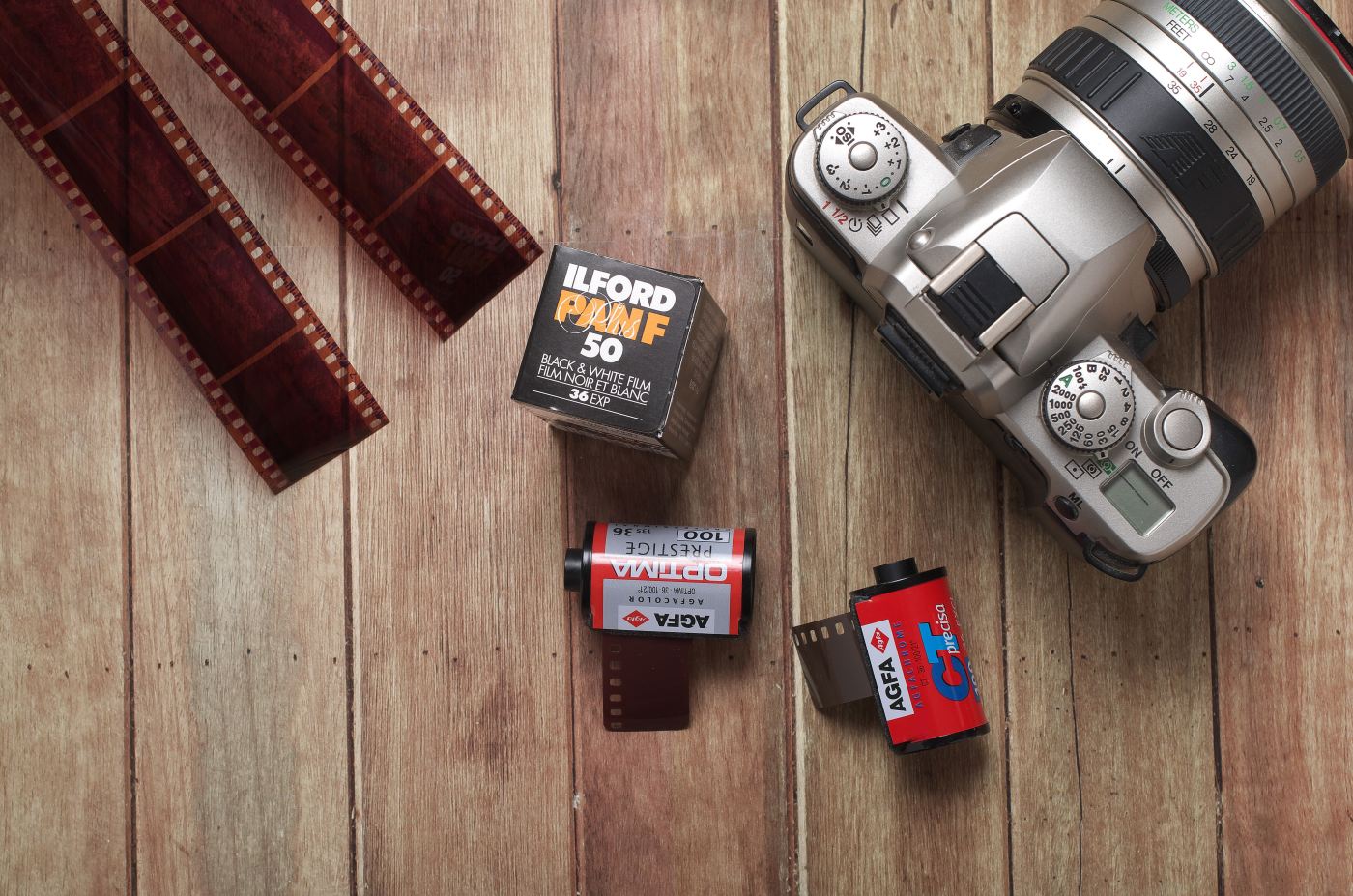
Before I could start with the practical implementation of my photography project, I needed to familiarise with the camera control of the 35mm SLR camera. Therefore, it was necessary to have a look at the relationship between aperture, shutter speed and ISO and the effect all of them have on the exposure of a photograph.
The total exposure of an image is made of the time the light strikes the film and the intensity of the light, both influenced by f-stops and shutter speed: While the f-stops controls the aperture of the lens over which light gets on the film, the shutter speed controls the duration of the film’s exposure to light. The ISO is important to regulate the light sensitivity of the camera sensor. Before using an analogue 35mm SLR camera it is important to understand that the „perfect“ exposure (meaning the image is neither overexposed nor underexposed) can be achieved with a lot of different combinations of these three settings: for a certain shooting situation f/8 and 1/60sec might have the same exposure than f/11 and 1/30 sec.
Before I have a closer look at those settings it is worth mentioning that each of them also influences other characteristics of the image: shutter speed shows or freezes movement, aperture affects the overall sharpness/depth of field and ISO may create (unwanted) image noise.
Aperture
The aperture of a camera controls the area over which light can pass through your camera lens and is specified in so-called f-stops like f/8 or f/22. It can be difficult to understand those terms because a low f-stop number means a wide opening of the lens while a high number indicates a small opening.
As already mentioned, changing the f-stops on the camera will affect the amount of light that enters the lens but also the depth of field (the overall sharpness of the image): A narrow aperture (high f-stop numbers like f/22 or f/32) with a small lens opening will lead to a deep depth of field and an overall sharpness from foreground to background. If the aperture is bigger (low f-stops numbers like f/2.8 or f/4) the depth of field will get shallow and only a small part of the photograph will be in focus.
Changing from one f-stop number to the next will change the exposure of the image by the factor of two: Stopping the aperture down from f/8 to f/11 will halve the exposure, opening it from f/8 to f/5.6 will double it.
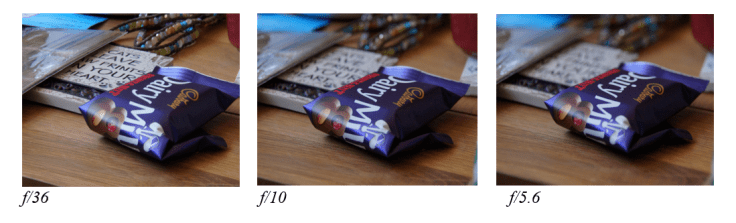
The pictures above I took with my digital SLR camera. The settings were the same in all three of them (90 mm focal length, ISO 400), but I set my camera to aperture priority and changed the f-stops. Because of the “law of reciprocity” the shutter speed changed as soon as I changed the f-stops. The first image was taken with f/16 and 1/3 sec, the second image with f/11 and 1/5 sec and the third one with f/5.6 and 1/125 sec. It is pretty obvious to see how the first picture has a larger depth of field as the third one: While the book and the bracelet are in focus in the first one, they are totally blurred in the last one.
Shutter Speed
A camera’s shutter is like a curtain that opens and closes after a certain amount of time. Therefore it controls the time interval during which light is allowed to pass through the lens to the film. On a 35mm SLR camera it is expressed as the denominator of the fraction that the actual speed is, for example 2 is ½ sec. A change in the shutter speed changes the exposure by the factor of two: 1/8 sec is twice as long as 1/15 sec, 1/15 sec is twice as long as 1/30 sec and so on. Even though shutter speed is an important way to control the exposure in the photograph it can be intentionally used to affect the appearance of movement: Using a fast shutter speed like 1/1000 of a second will freeze movements while a slower one (like 2 seconds) will show them.
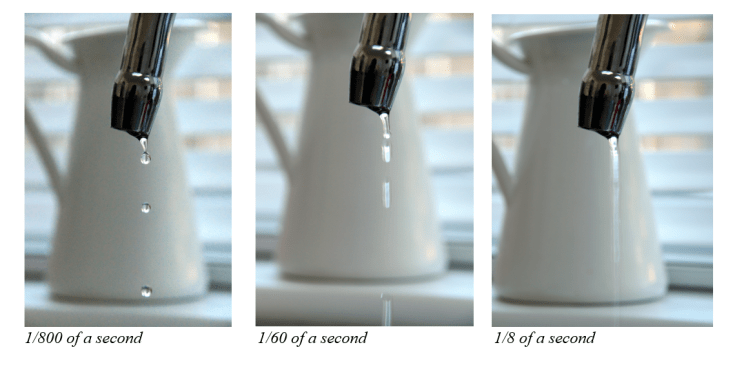
The pictures above show the influence of different shutter speeds: While the water drops are frozen individually at 1/800 sec, they are not visible at a shutter speed of 1/8 sec: the water blurred and shows the movements. With a shorter shutter speed, the action will freeze. For slow shutter speeds longer than 1/60 sec a tripod is needed to avoid camera shakes that will blur the image and set the objects out of focus.
It is important to reconsider the relationship between f-stops and shutter speed, also known as “law of reciprocity” (Graves, 1997, p. 23): If one wants to keep the same exposure in the image but experiment with different f-stops or rather shutter speeds, it is necessary to make a corresponding opposite change in the other because both of them together control the amount of light that gets on the film. For example, faster shutter speeds require smaller f-stops to make sure enough light gets on the film, while slower shutter speeds need a higher f-stop to avoid overexposure.
ISO
The ISO speed influences the sensitivity of the camera film to incoming light. A lower ISO is the better choice, because higher ISO speed will increase unwanted image noise, but sometimes it is necessary to go for a higher ISO number, for example in low-light-conditions. In our project we didn’t get to choose the ISO because the film we used had 400 ISO and it is not possible to change that. That’s why it was necessary to adjust the setting on the SLR camera to 400 ISO to make sure the light meter calculates the exposure for the correct light sensitivity.
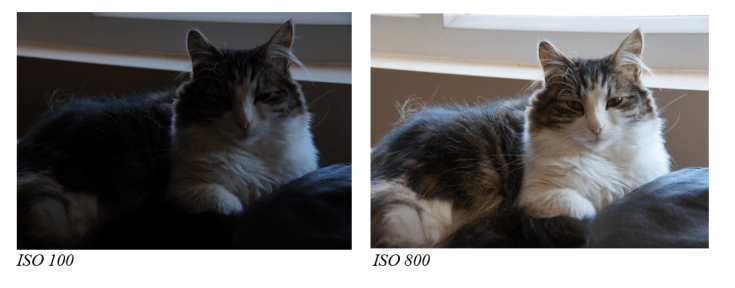
The pictures above show the same situation: the cat was photographed with a focal length of 60mm, a shutter speed of 1/50 sec and an aperture of f/22. The only thing that I changed manually was the ISO setting. ISO 100 is not suitable for this situation – the picture is way too dark. ISO 800 is better, even though a bit of image noise is already visible in the dark parts of the picture. If the ISO were even higher, the image noise would be very strong and will ruin the impact of the image.
Graves, C. (1997) The Zone System for 35mm Photographers. A Basic Guide to Exposure Control. Burlington: Focal Press. 2nd ed.
header photo: Wegmann, I. (2018) Analogue Camera. Available at: https://unsplash.com/photos/UHEVwbFJjHA (Accessed: 10 December 2019).
 Documentation of MEDI512 "Experiment"