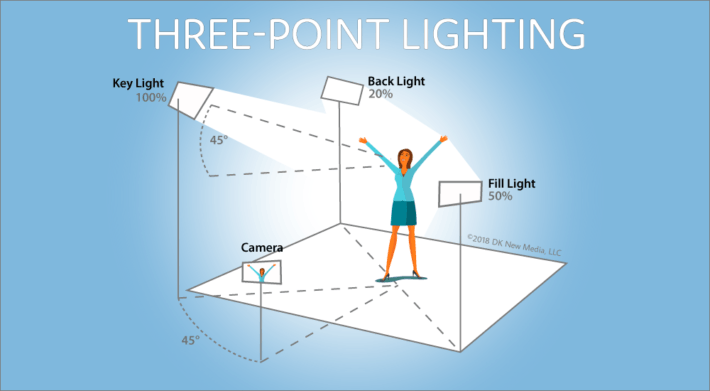
Craig Whyte introduced me to the standard lighting technique used in visual media such a film or photography, the so-called three-point lighting technique. This versatile but simple system forms the basis of most lighting and was essential for our following lighting exercise. The three lights that are used for this technique are called key light, fill light and back light. Filters or gels can be attached to all three lights to soften the light or change the colour temperature.
The key light is the most intense and direct light source of the entire scene. This primary light is the first to set up and illuminates the subject. Ideally, it is set up in a 45° angle from the camera.
The main function of the fill light is illuminating the shadows that are created by the key light. It is usually positioned on the opposite side of the key light and not as powerful. It is important that the fill light does not create any shadows by itself. In case there is no other light available, a reflector can also fulfil the function of a fill light: light will spill onto the reflector and bounce up to the subject.
The third light that is used in the three-point technique is the back light. It is placed behind the subject to light it from the rear. Its main purpose is to provide definition and subtle highlights around the subject’s outline. As a result, the subject seems separated from the background and gets a more three-dimensional look.
header photo: Lannom, S. (2019) 3-Point Lighting Diagram. Available at: https://www.studiobinder.com/blog/three-point-lighting-setup/ (Accessed: 09 December 2019).
 Documentation of MEDI512 "Experiment"